We are based on the local area and look at the worldHomepage - English
Hon Hai Group
Homepage
America
Mexico
Europe
Czech Republic
Slovakia
3+3+3 Event Highlights
"Hon Hai has dedicated themselves in developing R&D capabilities and investments in new industries with the introduction of the“3+3” (industry and technology) strategy.
Hon Hai has prioritized the three key industries: electric vehicles, digital health, and robotics industries, each has a significant growth potential with current scale at USD 1.4 trillion and over 20% compound annual growth rate. Hon Hai's own industrial experience and technology advantages will foster future development and growth.
The Group is also committed to developing artificial intelligence, semiconductors and next-generation communication technologies, building blocks in the Group's technology strategy.
Hon Hai showcases latest innovations and research results in its annual HHTD, Hon Hai Tech Day, sharing the achievements of the "3+3" strategy."
Event Information
Foxconn Industrializes Intelligence and Scales the Future With AI Factories
2026/10/26
Foxconn Industrializes Intelligence and Scales the Future With AI Factories
Foxconn is building an AI factory that turns industrial data into intelligence to power a self-learning manufacturing ecosystem. Using NVIDIA infrastructure and software, the company trains AI models and deploys specialized agents that support real-time decisions across manufacturing, electric vehicles, and smart cities. At the center is FoxBrain, Foxconn’s proprietary large language model, developed by adapting open foundation models with industrial data. FoxBrain supports specialized platforms, including Genesis for manufacturing and CityGPT for urban services. NVIDIA DGX SuperPOD serves as the AI factory’s training foundation. Foxconn reports 2.48x faster training for 120-billion-parameter models compared with its previous H100-based systems, processing one trillion tokens in 12 days. NVIDIA software helps manage infrastructure and deploy AI agents across more than 200 facilities. The company reports practical manufacturing improvements: 25% fewer labor hours spent on production scheduling. 50% less engineering workload for injection-molding process changeovers. More than 20 major defect root causes addressed, with a correction rate exceeding 90%, on surface-mount production lines. Foxconn also uses NVIDIA RTX PRO servers, Omniverse, and Isaac to simulate factories and robots before deployment, helping replicate production lines globally. Through its subsidiary Visionbay.ai, an NVIDIA Cloud Partner, Foxconn is extending its AI factory leveraging NVIDIA-Certified Systems to deliver AI-as-a-Service to enterprises and governments across Asia. Discover how Foxconn and NVIDIA are architecting the future of industrial intelligence. Read the full Foxconn DGX SuperPOD case study.
2026/10/26
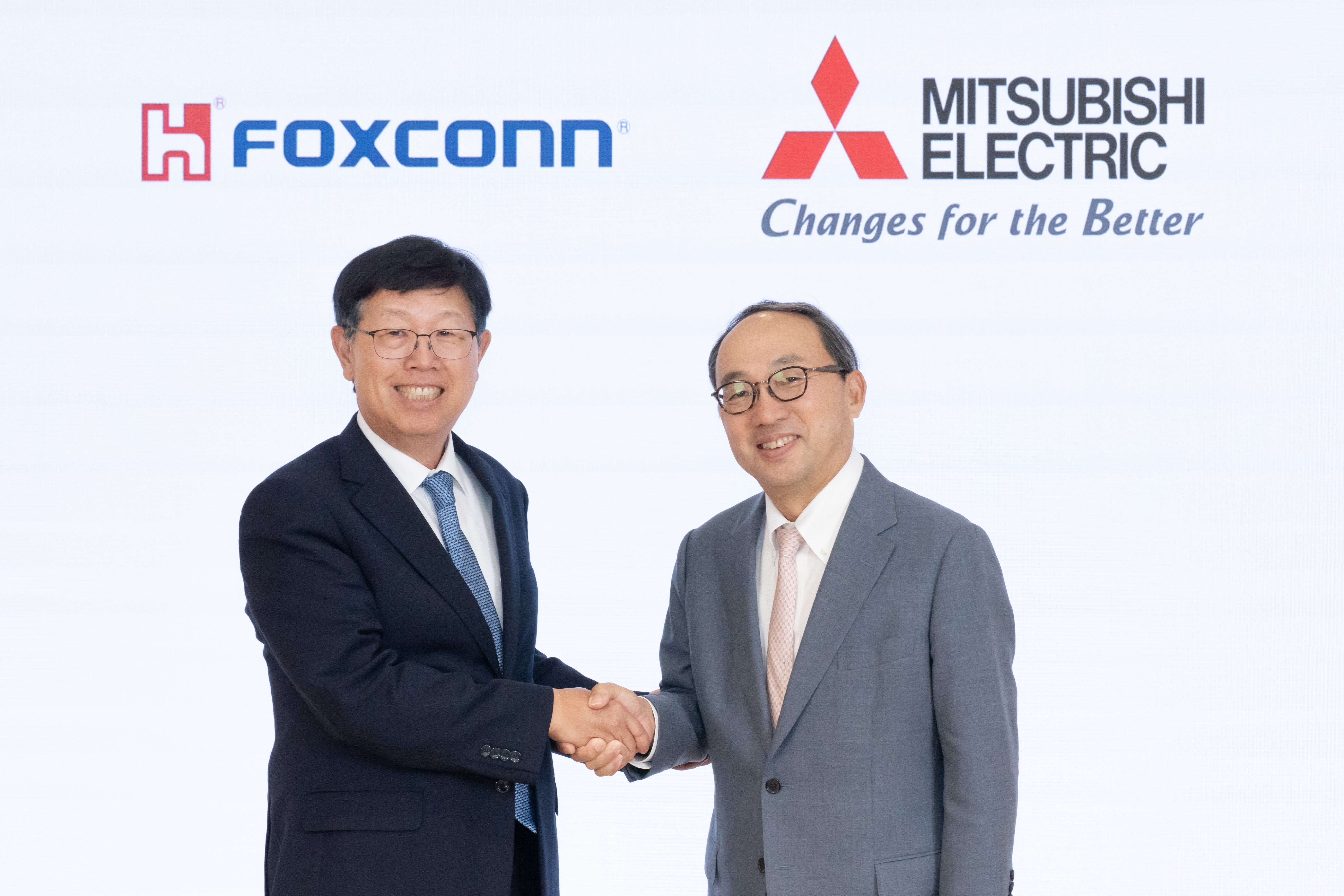
Hon Hai Precision Industry (Foxconn) and Mitsubishi Electric Reach  Final Agreement on Strategic Alliance for Joint Operation of Automotive Equipment Business
2026/10/16
Hon Hai Precision Industry (Foxconn) and Mitsubishi Electric Reach Final Agreement on Strategic Alliance for Joint Operation of Automotive Equipment Business
Will leverage “Made in/by Japan” brand to support sustainable growth of Japanese automotive industry16 October 2026, Taipei, Taiwan, Tokyo Japan – Lin Yin International Investment Co., Ltd. (Lin Yin), an investment management subsidiary of Hon Hai Precision Industry Co., Ltd. (Hon Hai Precision Industry) (Foxconn), and Mitsubishi Electric Corporation (Mitsubishi Electric) announced today that they have formalized a strategic alliance for the joint operation of an automotive equipment business. Through the alliance, the companies aim to develop next-generation mobility and thereby strengthen the sustainable growth of the Japanese automotive industry. Under the agreement, Mitsubishi Electric will transfer to Lin Yin 50% of its stake in Mitsubishi Electric Mobility Co., Ltd., which handles Mitsubishi Electric’s automotive equipment business, after which the two co-owners will jointly operate Mitsubishi Electric Mobility. The share transfer price is expected to be JPY 115.0 billion. The share transfer agreement establishes an enterprise value of JPY 320.0 billion and an equity value of 230.0 billion for the target business. The transfer price corresponds to a 50% stake to be transferred based on the equity value. Subject to the satisfaction of contractual conditions, including obtaining required approvals and clearances from relevant authorities under competition laws and other applicable laws and regulations, the share transfer is expected to be completed on October 1, 2027. The joint-operating arrangement will combine Mitsubishi Electric Mobility’s technological and developmental capabilities, particularly in electric powertrains, software and vehicle control, with Hon Hai Precision Industry’s speed, scale and other strengths in market deployment. By providing high-quality electric-vehicle platforms (basic structures) developed in Japan, the companies expect to contribute to the widespread adoption and advancement of next-generation mobility. The alliance will translate advanced technologies and quality achieved through high-level Japanese manufacturing into new value for mobility. In turn, this is expected to strengthen Japan’s industrial base and support the sustainable growth of the domestic automotive industry. In addition, over the medium to long term, the companies aim to expand Japanese technology and quality to global markets as well as further enhance the value of “Made in/by Japan” and demonstrate new possibilities for Japanese manufacturing to the world. About Hon Hai Hon Hai Technology Group (Foxconn) (TWSE:2317) is the world’s largest electronics manufacturer and leading technology solutions provider, ranking 23rd in Fortune Global 500. In 2025, revenue totaled TWD8.1 trillion (approx. USD260 billion). The Group’s market share in electronics manufacturing services (EMS) exceeds 40% and covers four major product segments: smart consumer electronics; cloud and networking; computing; and components and other. Operating over 240 campuses across 24 countries, Foxconn is one of the world’s largest employers with approx. 1 million employees during peak manufacturing season. We are committed to sustainability in the manufacturing process and serving as a best-practice model for global enterprises. The Group is guided by its 3+3+3 strategy, actively investing in industries of electric vehicles, digital health, and robotics; in technologies of artificial intelligence, semiconductors and next-generation communications; in intelligent platforms of Smart Manufacturing, Smart EV and Smart City. Foxconn is dedicated to becoming a comprehensive, world-class enterprise, with AI as its core driving force. Learn more at www.foxconn.com/en-us About the Mitsubishi Electric Group Guided by its corporate philosophy, Mitsubishi Electric Corporation (TOKYO: 6503) places sustainability at the core of its operations and values stakeholder trust—encompassing society, customers, shareholders and employees. In pursuing profitability, capital efficiency and growth, Mitsubishi Electric works closely alongside customers to develop value-added solutions that address today’s complex challenges while enhancing the company’s sustainable corporate value. Founded in 1921, Mitsubishi Electric has over a century of experience in delivering reliable, high-quality products and solutions. With over 200 group companies and approximately 150,000 employees worldwide, the company is a recognized global leader in manufacturing, marketing and selling electrical and electronic equipment and systems across a broad range of sectors, including public utility systems, energy systems, defense and space systems, factory automation systems, automotive equipment, building systems, air conditioning systems & home products, digital innovations, and semiconductor & devices. Mitsubishi Electric recorded consolidated revenue of 5,894.7 billion yen (U.S.$ 36.8 billion*) in the fiscal year that ended on March 31, 2026. For more information, please visit www.MitsubishiElectric.com *JPY 160=USD 1, the approximate rate on the Tokyo Foreign Exchange Market on March 31, 2026
2026/10/16
Hon Hai Research Institute’s Two Quantum Works Accepted by FOCS 2026, World's Top Theoretical Computer Science Conference
2026/10/08
Hon Hai Research Institute’s Two Quantum Works Accepted by FOCS 2026, World's Top Theoretical Computer Science Conference
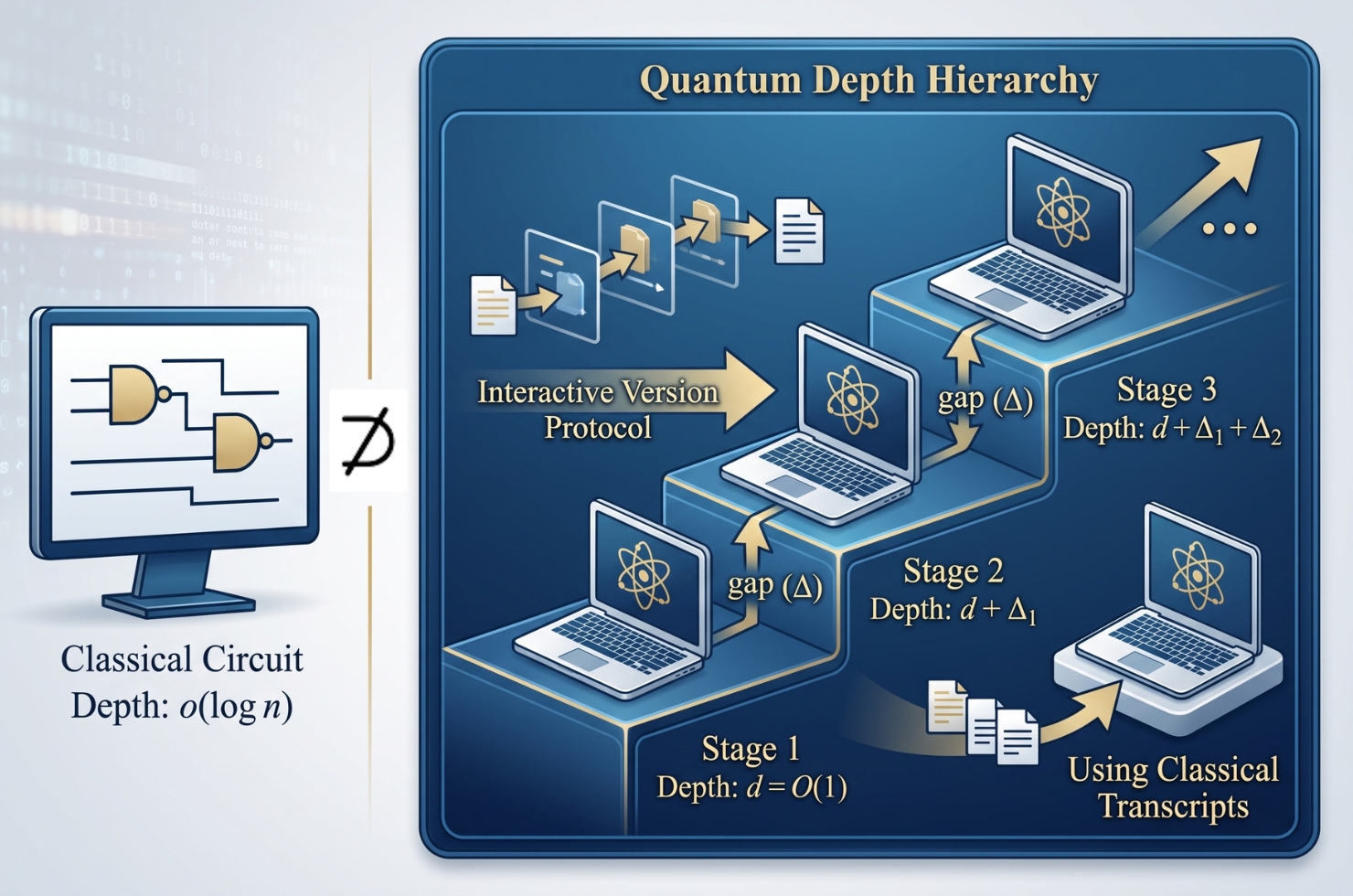
08 October 2026, Taipei, Taiwan – Demonstrating its strong forward-looking R&D capabilities, two fundamental theoretical studies from the Hon Hai Research Institute, under Hon Hai Technology Group (Foxconn), have been accepted by the IEEE Symposium on Foundations of Computer Science (FOCS 2026), universally recognized as the highest distinction in theoretical computer science. The 67th Annual FOCS 2026 will take place from November 8-11, 2026, in New York City, USA. As a flagship conference hosted by IEEE, FOCS stands alongside ACM's STOC as the premier academic venue in global theoretical computer science. The conference focuses on underlying mathematical theories such as algorithm design, computational complexity, cryptography, and quantum computing. The studies were conducted by Min-Hsiu Hsieh, Director of HHRI’s Quantum Computing Research Center, Researcher Michael de Oliveira, Intern Ding-Jun Lin, Intern Adam Wills, and an international collaborative team have both. The two accepted papers—"Worst-case depth hierarchy for shallow quantum circuits" (arXiv:2606.16425) and "Linear-Time Encodable and Decodable Quantum Error-Correcting Codes" (arXiv:2603.04543)—are not only the annual flagship achievements of the Hon Hai Research Institute’s Quantum Computing Research Center, but FOCS itself is a top-tier global theoretical computer science conference with an extremely high acceptance threshold. Notably, among all papers accepted by FOCS this year, Hon Hai Research Institute is the sole research entity representing Taiwan, fully highlighting Foxconn’s leadership in key foundational infrastructure for next-generation quantum technology. Mapping the Limits of Quantum Computational Power to Guide Algorithm Design The first accepted paper, "Worst-case depth hierarchy for shallow quantum circuits," focuses on the "depth hierarchy theory for shallow quantum circuits." In quantum computing, "circuit depth" resembles the total number of sequential steps that must be executed (equivalent to run time). Current quantum hardware, limited by technology, can only execute "shallow computations" with few steps and short run times. However, the scientific community has historically struggled to rigorously prove precisely how much of a leap in quantum computational capability occurs if the run time is increased by just a few additional steps. HHRI’s research team successfully established a mathematical framework that rigorously proves that for every additional layer of computational steps, the problem-solving domain of a quantum computer exhibits a distinct "hierarchical jump." This result is akin to mapping a precise "quantum computational capability chart," helping scientists worldwide clearly grasp the boundaries of current quantum devices, enabling the development of more efficient algorithms, and accelerating the realization of high-performance quantum computers. Equipping Qubits with "Ultra-Fast Protective Armor" to Build Ultra-Low Latency Error-Correction Technology The second paper, "Linear-Time Encodable and Decodable Quantum Error-Correcting Codes," tackles the most challenging noise issue in quantum computing—"linear-time encodable and decodable quantum error-correcting codes." While quantum computers possess immense processing power, qubits are extremely fragile. Minor temperature fluctuations or noise interference from the surrounding environment can instantaneously collapse the computational information. Therefore, quantum computers must detect and repair errors in real time within extremely short timeframes. However, if the computation for error correction and encoding is overly complex and time-consuming, qubits will degrade before the errors can even be fixed. The Quantum Computing Research Center team successfully developed an innovative encoding and decoding architecture that vastly simplifies the correction process, allowing computers to complete error-correction in highly efficient "linear time." This breakthrough is like equipping qubits with smart armor capable of "instant self-repair," laying a crucial cornerstone for building large-scale, stably operating quantum computers and quantum communication networks in the future. Cultivating Foundational Theory to Lead Next-Generation Technology Quantum technology is regarded as the core technology set to disrupt future cybersecurity, materials science, finance, and artificial intelligence. Yet, every hardware engineering breakthrough must be built on a foundation of underlying mathematics and algorithmic theory. HHRI director Hsieh stated that being the sole selection from Taiwan at this top-tier conference not only demonstrates that Taiwan's research in quantum foundational theory has reached world-class standards, but also confirms Foxconn’s commitment to cultivating advanced science and nurturing young scientific talent. Moving forward, the Quantum Computing Research Center will continue to collaborate with world-class research teams to provide the most solid theoretical support for next-generation technological infrastructure.
2026/10/08
Past HHTD
HHTD24
HHTD24
HHTD23
HHTD23